Coolblue · Internal product
Turning a fragmented vendor workflow into a decision-making product
I led research and product design for Vendy, a web application that helped Coolblue buyers move from monitoring product performance to taking confident, proactive action with vendors.
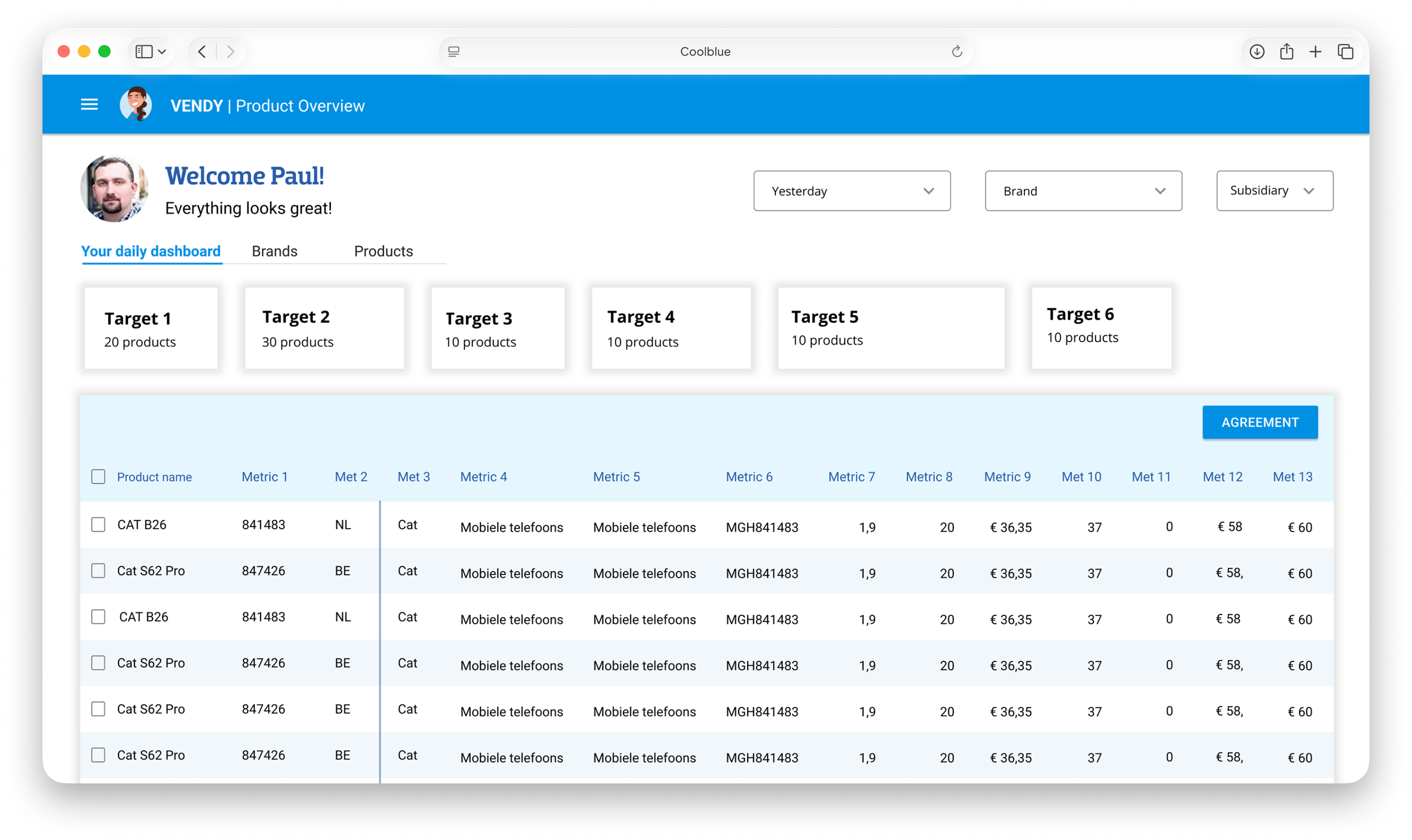
The workflow had data, but not enough agency
Coolblue buyers were accountable for the assortment and commercial performance of an entire product category. To negotiate better conditions with vendors, they had to identify underperforming products, prepare a proposal, manage the negotiation and create the final agreement.
That process could take a considerable amount of time. The buyers moved between multiple applications, copied information manually and spent more time checking data than acting on it. The vendors also experienced missing information and miscommunication, with no shared place to track the negotiation.
The design question
How might we help buyers move from monitoring and administration to confident, proactive negotiation?
Research the work, not only the interface
I combined three research inputs to understand both sides of the negotiation and the reality of a buyer’s day-to-day workflow.
- buyer survey: Conducted a survey with 40% responses; buyers wanted high-level and detailed data together, with clear next best actions.
- vendor interviews: Five priority vendors described missing information, miscommunication and the need for a shared source of truth.
- Diary study: Only 34% of the buyer's workflow was productive work.
The most important insight was not simply “too many tools.” The workflow separated seeing an opportunity from acting on it. That gap created delay, duplication and uncertainty for both buyers and vendors.
Where the work went during the week
| Day | Administration | Analysis | Negotiation | Proposal |
|---|---|---|---|---|
| Monday | 25% | 50% | 12.5% | 12.5% |
| Tuesday | 18% | 51% | 15% | 16% |
| Wednesday | 15% | 58% | 16% | 11% |
| Thursday | 15% | 65% | 13% | 7% |
| Friday | 25% | 65% | 4% | 6% |
Design one path from signal to agreement
We reframed the opportunity from “build a portal” to “create one connected workflow.” Vendy brought product analysis, proposal creation, negotiation and agreement tracking into a single experience.
Three principles shaped the MVP
- Make insight actionable: surface the information needed to decide what to do next, not just what happened.
- Make the negotiation shared: give buyers and vendors a clearer common reference point.
- Make the process repeatable: reduce the manual workarounds that made the process slow and error-prone.
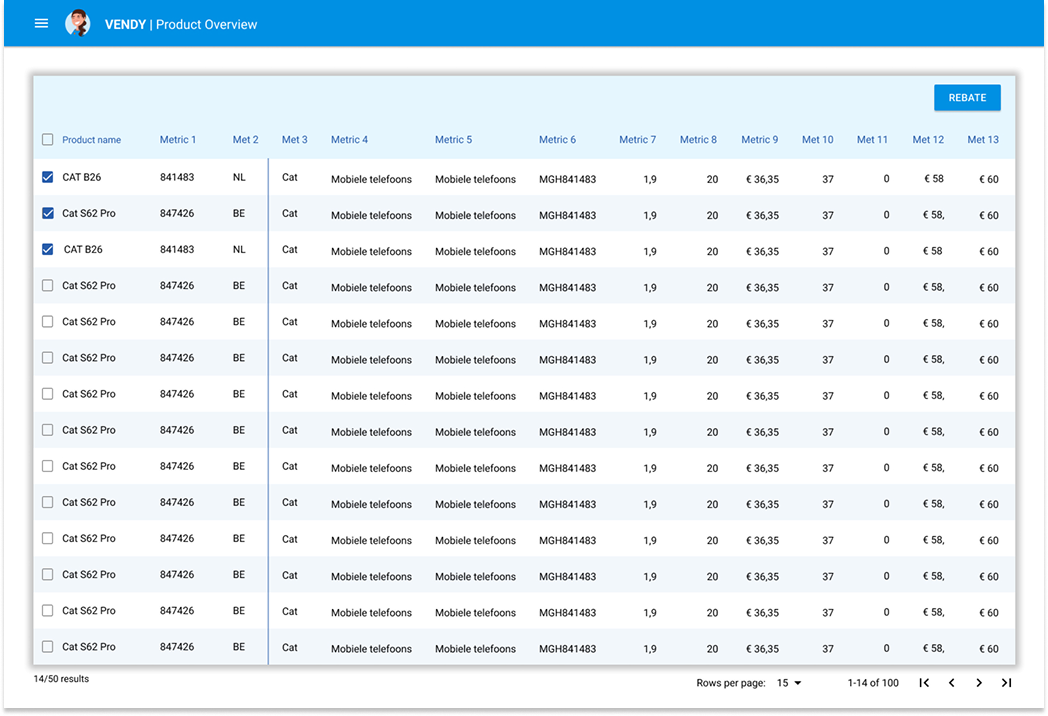
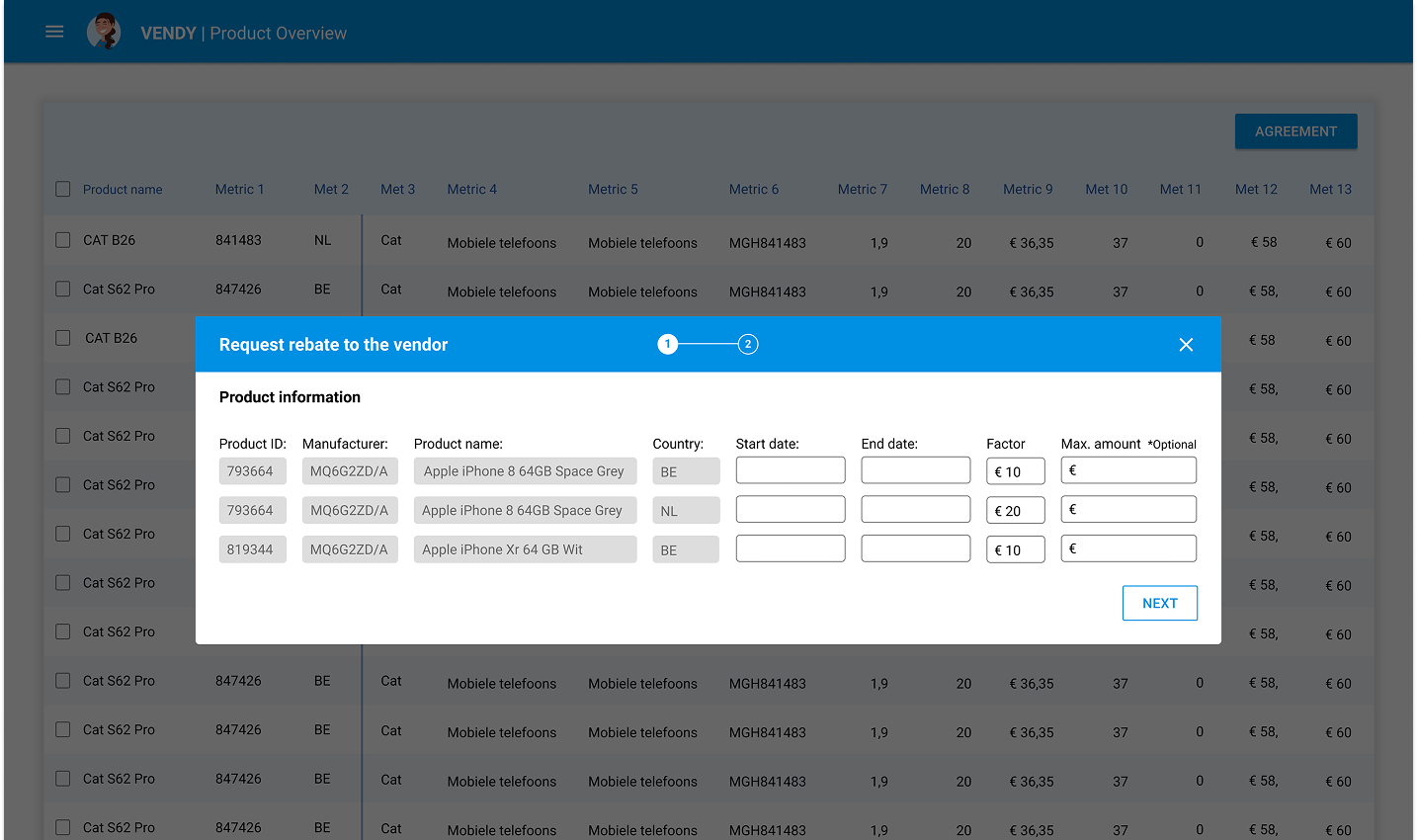
The resulting flow let buyers monitor products, prepare and send a proposal, receive a vendor response and create an agreement without switching between disconnected tools.
Make prioritisation a shared decision
I ran three focus groups with five buyers each over one month. The sessions moved from understanding the data buyers needed, to sketching the experience, testing concepts and deciding what belonged in the first release.
To make trade-offs explicit, I facilitated a “Buy your feature” workshop. Each buyer received a fixed budget and spent it on the capabilities they valued most. The features clustered into five areas: analysis, proposal, negotiation, administration and user management.
This gave the team a concrete way to negotiate scope. Product and engineering could see why a feature mattered, while buyers could shape an MVP grounded in their real work rather than an abstract list of requests.
The MVP will consist of allowing buyers to monitor products and create agreements for selected products.
The MVP proved the direction and clarified the next bets
We evaluated the first release against user satisfaction, adoption and the time required to identify underperforming products.
Measured results
The results were directionally strong, but not a reason to declare the problem solved. The MVP validated the need for a connected workflow while showing where the product still had to grow.
The next opportunities were clear: add target filters, support more agreement types and automate additional steps. That is the value of a well-scoped MVP: it turns a broad ambition into evidence-backed product decisions.
What I take forward
Vendy reinforced that strong product design starts with understanding the system around the interface. These are the principles I carry into my work:
- Design for a system: look beyond the screen to understand the relationships, constraints and decisions that shape the experience.
- Understand the profession: get deep into how buyers and vendors really work, so the product responds to their workflow rather than an assumed version of it.
- Choose pragmatism and UX over UI: focus on making the work clearer and more effective before polishing the interface.
- Do the research well: invest in understanding the problem properly, while staying honest about what research can and cannot predict.
- Ship in small increments: launch focused improvements, learn from real behaviour and stay able to change direction. Research reduces uncertainty, but you only learn how a product performs when people use it.